For somebody who has not done this
A First Visit, Arranged by Place Rather Than by Clock
This publication is read mostly by people who are coming here to look at something they have not looked at before. Below is an order that works, built around places rather than around a timetable, because there is no timetable to build around.
Why this is not a schedule
Every plan that assigns an hour to each place fails here, because the thing you came to see is not under anybody's control. A hull arrives when it arrives. A span opens when a hull asks it to. A berth is busy or it is not.
So this is an order of places, not of times, and it is built so that each step is worth doing on its own. If you only get through the first two, you will still have seen the subject.
First: get above it
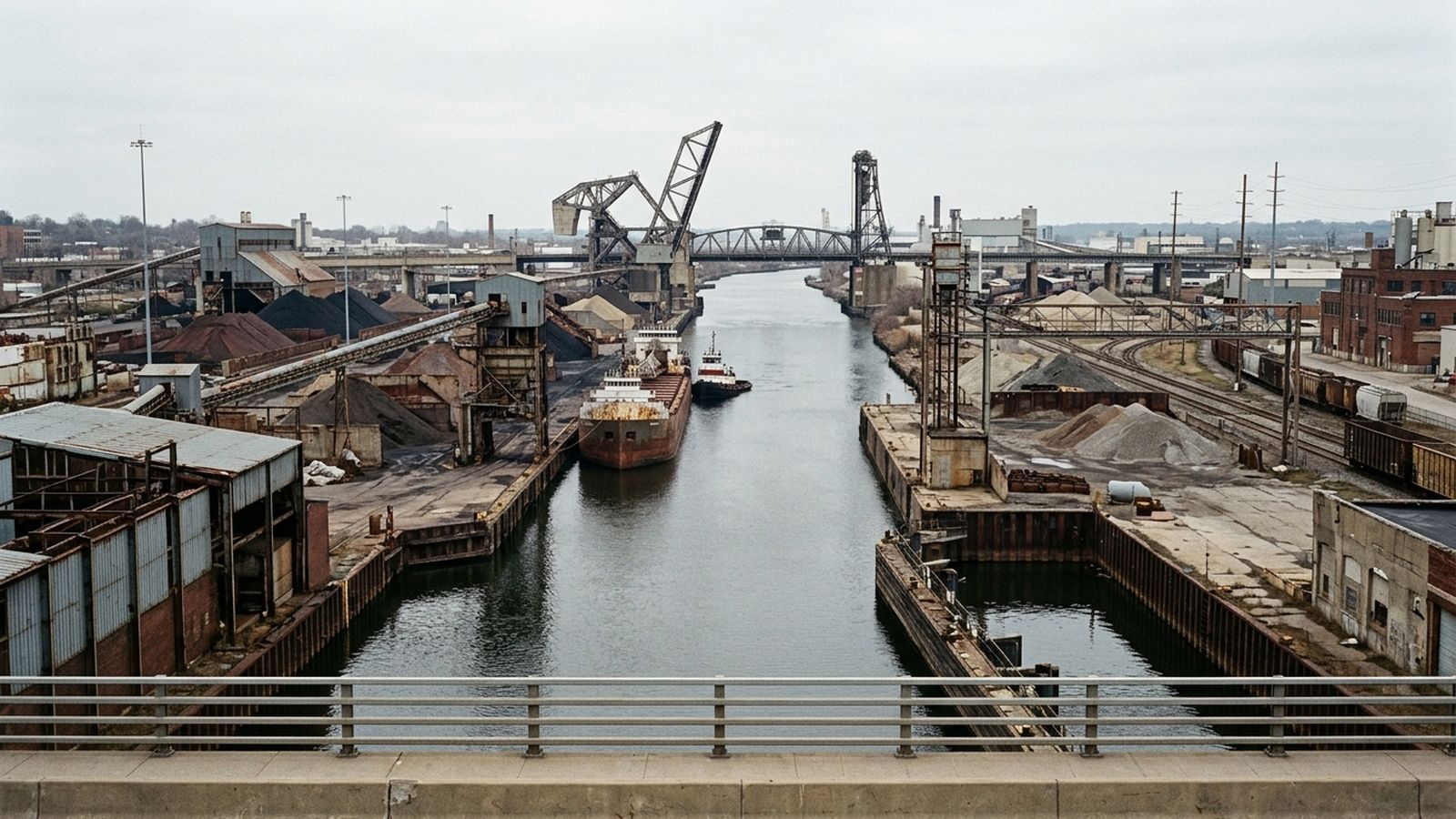
Start high, on a viaduct sidewalk, and spend twenty minutes doing nothing but working out the plan of the place. Which way does the channel run. Where are the movable spans relative to each other. Where do the rail lines cross, above and below. Where are the docks, and which of them has something at it today.
This is the least dramatic part of a first visit and the one that makes the rest legible. Everything you do afterwards will be inside the arrangement you just looked at from above, and you will know which direction a hull is coming from.
A practical note: the wind on a high deck is constant. Twenty minutes is about the length of time this is pleasant, which is conveniently also about the length of time it takes.
Second: stand at a movable span
Come down and find a span with a sidewalk. Read it before anything happens: find the counterweight, the gates, the joint in the roadway if it has one, the operator's house. How a lift span works tells you what you are looking at.
Then wait, on the fixed approach and not on the movable deck. If a span opens while you are there, you have seen the whole subject in nine minutes. If it does not, you have still read a machine at arm's length, which no photograph does for you.
This is the step to protect if your day gets short. Of everything in this publication, a span sidewalk is the one place that repays a single visit.
Third: go down to the valley floor
Now the change in scale. Find a street that ends at the channel and walk to the end of it. A loaded hull from up on a viaduct is a shape. From a street end it is a wall with rivets, and the difference is the reason people come back.
If a berth is working, stay. Unloading takes hours, and the first ten minutes of watching a boom is not the interesting part. The interesting part is noticing how the pile grows along one axis, and how the operation adjusts.
Warnings, plainly: industrial road, truck traffic, frequently no sidewalk, and rail crossings that can close for a long time behind a slow move rather than a train. Where to stand says which of the four vantage types this is and what is wrong with it.
Fourth, and optional: the mouth
Out past the built up part, where a hull either arrives or leaves and there is nothing in between. This is the best sight in the subject and the worst use of a first visit, because it is a long walk out and there is a good chance nothing comes while you are there.
Save it for a second visit, or do it if you have already seen a hull moving in the channel and want to see where it came in.
What to leave out of a first visit
- The salt operation. The interesting part is underground and you cannot see it, and what is above ground is under a roof. Read about it instead.
- Chasing an opening. You cannot. Stand somewhere good and let it happen or not.
- Trying to do all four steps and the mouth in one go. Three of these done properly beats five done at walking pace.
Two questions people ask before coming
How long does this take? Half a day covers the first three steps without rushing. A full day covers all four and leaves time for waiting, which is most of it.
Is there anything to do if nothing is moving? Yes, and this is the honest answer nobody gives. A closed span is still a machine and can be read. An empty berth still shows you the handling arrangement. A rail crossing with nothing on it still shows you where the lines go. The subject is infrastructure, and infrastructure is there whether it is working or not.
Getting here, and the one thing we are paid for
Getting there covers arriving in this city and moving around it once you have.
That page also carries a flight search, and so does the foot of the front page. It is run by an outside booking service, not by this publication, and a booking made through it can pay us a commission. Nothing else on this site earns anything. The disclaimer sets that out in full.