The vantage points
Places a Visitor Can Stand, and What Is Wrong With Each of Them
Every vantage point in this publication is somewhere anybody can walk to without asking. That does not make them all pleasant. Below, what each kind shows you and what it costs in noise, wind, traffic or waiting.
The rule this publication works to
Only places anybody can walk to. No gate is passed, no fence is climbed, no permission is implied and no operating dock is entered. A working dock is somebody's workplace with equipment moving on it, and a visitor standing on it is a hazard to himself and an interruption to a shift.
That rule costs you some views and is worth it. It also means every place described here can be checked by you against reality without a phone call, which is the standard this publication holds itself to.
The four kinds of vantage point
Almost everything worth standing at falls into one of four types, and each type has a characteristic failure.
| Type | What it gives you | What is wrong with it |
|---|---|---|
| Span sidewalk | The mechanism from inches away, and the channel in both directions | Traffic behind you, and you must be off the deck before it opens |
| Street end on the valley floor | Hull at eye level, unloading close enough to hear | Often no sidewalk, sometimes a rail crossing to wait at |
| High viaduct sidewalk | The whole channel plan at once, spans and rail together | Wind, height, and everything is small |
| Pier or breakwater | Arrivals and departures, and open water behind them | Long walk out, no shelter, and nothing at all if no hull comes |
Span sidewalks
The best single introduction to the subject, and the one place where you can see what a movable bridge actually is. You are standing on a structure that is about to become something else.
What it gives you: the counterweight track, the gates, the lock bars, the joint in the roadway, and the operator's house. Also the channel in both directions, which lets you see a hull approaching for several minutes before it arrives.
What is wrong with it: there is road traffic a few feet behind you, sometimes with no barrier beyond a curb line. The sidewalk is narrow. And the fundamental problem, which nobody mentions: you cannot be on the movable deck when it opens, so the moment you came for is the moment you have to have already left. Stand on the fixed approach, not on the leaf.
For children, the fixed approach is fine and the deck is not. Nobody should be working out where the joint is with a child's hand in theirs.
Street ends on the valley floor
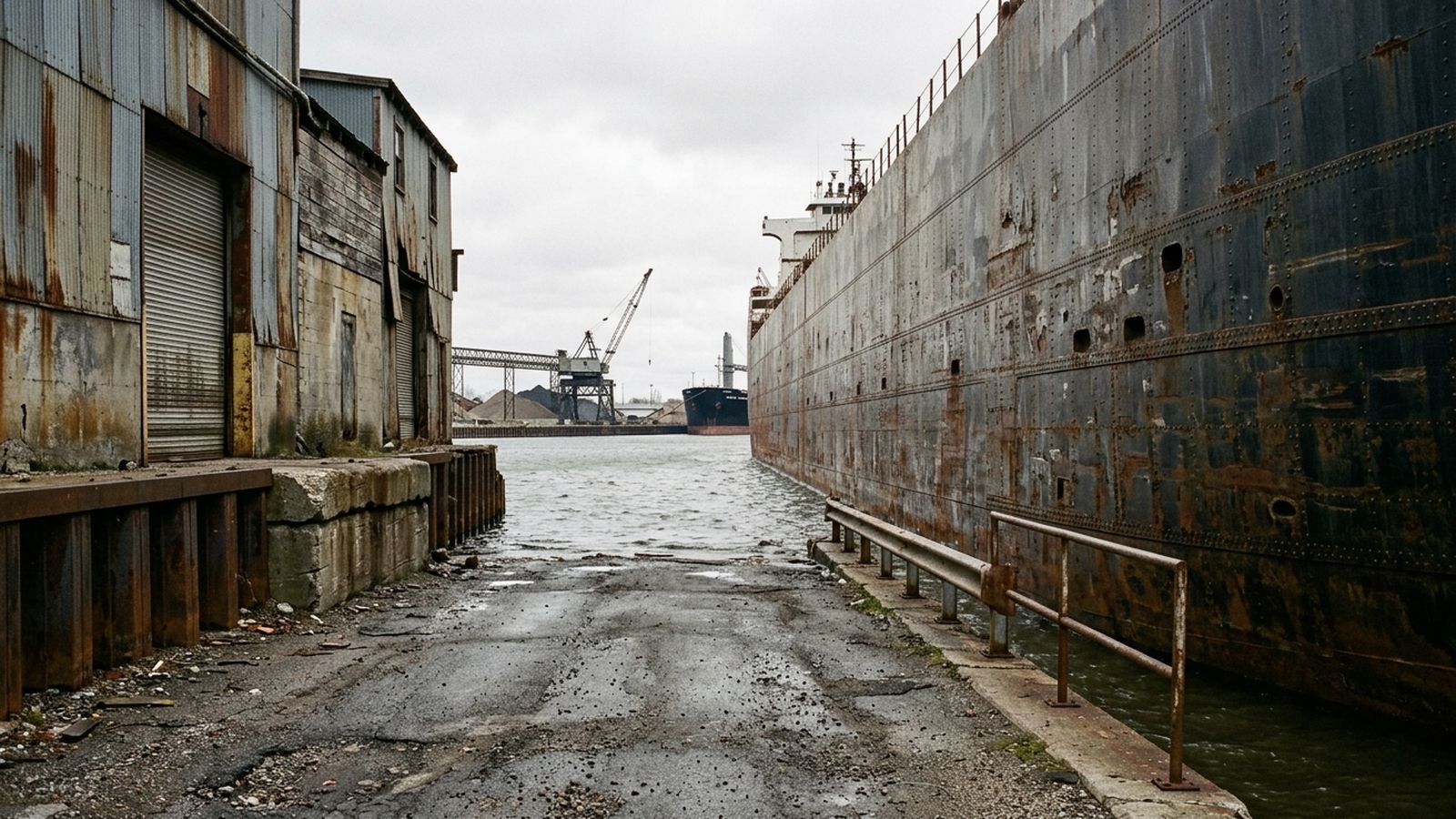
Down at water level, several streets stop at the channel or run out along it. These are the closest legal look at an unloading operation, and the difference in scale from up on a viaduct is hard to overstate: a hull that was a shape becomes a wall.
What it gives you: the boom over your head or nearly, the sound of material landing, trucks and a scale if it is a stone berth, and the sheer height of a loaded hull's flank.
What is wrong with it: this is industrial road with truck traffic and often no sidewalk at all. There are rail crossings, and a crossing here can be closed for a long time by a slow move rather than a passing train. There is not usually anywhere to sit, and there is nothing at all to do if the berth is empty.
Do not do this in the dark. Not for safety theatre reasons, but because there is nothing to see and the traffic will not expect you.
High viaduct sidewalks
Two useful things happen from a viaduct sidewalk. You see the plan of the whole thing: how the channel bends, where the movable spans sit relative to each other, and how the rail lines cross above and below. And you see the freight deck of a structure from above, which is a view of infrastructure you almost never get.
What it gives you: geometry, and the relationship between parts.
What is wrong with it: everything is far away, so detail is lost. The wind on an exposed high deck is real and constant and will make a long stay unpleasant. And a high sidewalk with heavy traffic beside it is loud in a way that gets tiring faster than you expect.
Piers and outer walls
Out at the mouth, past the built up part, the arrangement is different: this is where a hull is either arriving or leaving, and there is nothing to look at in between.
What it gives you: the approach and the turn in, the actual moment of a large hull changing direction, and open water behind it for scale.
What is wrong with it: it is a long walk out and a long walk back with no shelter at either end. There is nothing to do if nothing comes. Wet stone is slippery. And the outer end of a wall is not a place to be if the water is up.
The one place that is not on this list
Anywhere that requires passing a gate, going round a barrier, or standing on an operating dock. This publication does not describe those places and will not, and if you find a page elsewhere that does, notice that it is asking you to trespass on a working industrial site.
Practical, and short
- The wait is the activity. Bring something to do. A span opening is not a scheduled event, and a berth can be quiet for an hour.
- Sound arrives before sight. A bell at a gate, a change in a motor note, a prolonged whistle: all of them precede anything visible.
- Stand where you can leave. Every vantage point in this publication is somewhere you can walk away from in ten seconds. If a place does not have that property, it is not on the list.
- A tripod is a nuisance on a span sidewalk and a hazard on a street with truck traffic. Handheld is the right answer at all four types.
- Nothing here needs a ticket, a booking or a fee, which is also why this publication has nothing to sell you about it.
Where the individual places are written up
The eight watches each take one place, one mechanism and one load, and each of them says where you stand and what is wrong with it in the first two lines. If you want a route rather than a list, a first visit puts them in an order.