The load
Four Cargoes, and How to Tell Them Apart From a Sidewalk
A hull tied up at a dock tells you almost nothing until you know what is coming out of it. These four account for nearly everything, and each one unloads in a way you can read from a few hundred feet away.
Start with the shape of the hull
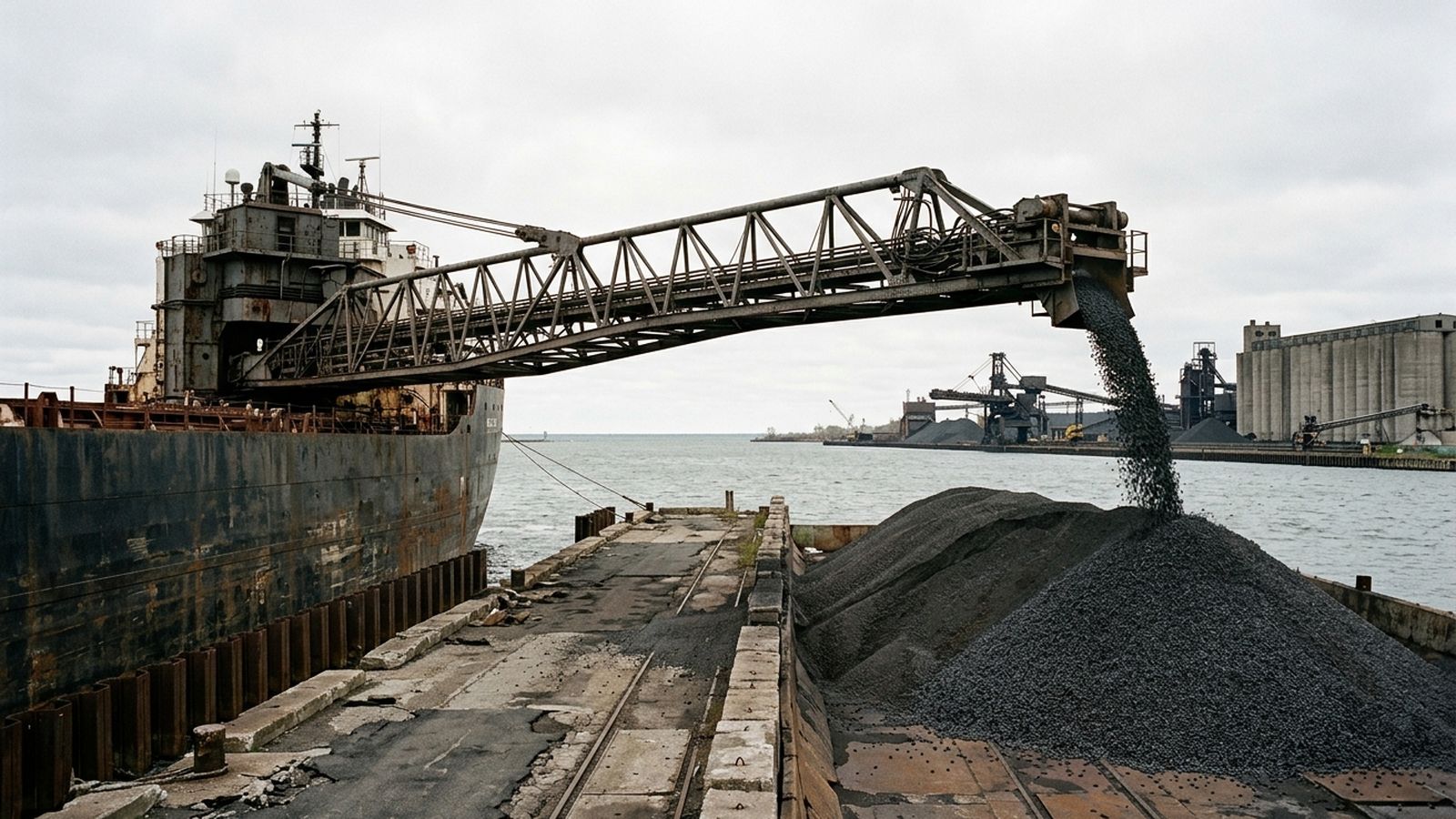
Before the cargo, the boat. Almost every hull working this channel is a self unloader, which means it carries its own machinery for getting the cargo out and does not need a crane on the dock. Look for a long boom, usually stowed along the centerline and swung out over the side when work starts. A hull without that boom is a straight decker and needs shore equipment, which on this channel is rare enough that it is worth stopping for.
The second thing to read is how far out of the water the hull is sitting. A loaded hull sits low, with very little of the side plating showing above the waterline, and it moves slowly and deliberately. The same hull empty rides high enough that you can see the whole flank and the rubbing strakes along it. If you watch a berth for two hours you will see the same vessel go from one to the other, and the difference is the clearest illustration of tonnage anybody could ask for.
Iron ore pellets
Ore is the reason the channel exists at its present depth. Pellets arrive as small hard spheres, roughly marble sized, produced at the mines and shipped rather than raw rock, because pellets flow and raw rock does not.
Unloading looks like this. The boom swings out and down over a stockpile. A dark stream falls off the end of it, and the stream does not stop. From a distance the sound is a continuous rush, not a series of thuds, and the pile grows visibly along one axis rather than in the middle. A single hull can take most of a shift to empty, which is why an ore berth is the most reliable thing to watch: come back three hours later and it will still be going.
Two details worth knowing. Pellets are much heavier than they look, so a stockpile that seems modest represents a great deal of tonnage. And the color of the pile tells you something about where it came from, ranging from dull rust to something closer to dark gray, though this is a weak signal and not worth guessing at out loud.
Limestone and aggregate
Stone is coarser, lighter per shovel and noisier. The stream off the boom is uneven, and you can hear individual pieces landing. The pile is steeper than an ore pile and slumps more.
Stone also comes with trucks. Ore mostly leaves a dock by rail or conveyor, but aggregate leaves by road, which means a scale, a queue and a gate. If you want to see the whole chain from hull to highway in one visit, a stone dock is the one that shows it.
Salt
Salt is the local peculiarity, and the part of this that surprises visitors most. It is not brought in from somewhere else. It is mined from under the lake, and the shaft head is on the shore. What you see from outside is a hoist house, a headframe and a covered pile, because salt cannot be left in the open.
You will not see much of the mining and there is nothing to look at underground. What is visible and worth the trip is the surface arrangement: the difference between a structure built to lift material vertically out of the ground and a structure built to take material sideways out of a hull. They look nothing alike, and standing where you can see both in one view explains more about industrial handling than a paragraph can.
Everything else
The remainder is general cargo and the occasional oversize piece. This is the least predictable and the most interesting when it happens: machinery on flat racks, sections too large for a truck, pieces braced and chained in a way that tells you somebody spent a day thinking about it.
There is no schedule you can consult for this. It is a matter of noticing that a berth which is usually empty has something at it and going to look.
Why the shares matter to a visitor
Because they tell you what you are likely to see. If two thirds of the tonnage is ore, then on an ordinary working day an ore operation is the most probable thing happening, and a plan built around it will usually work. Salt is under a roof and mostly invisible, so a trip built around watching salt move will usually disappoint. Stone is the compromise: less of it, but more of it visible, and more of it happening at street level where you can stand close.
None of that is a timetable. Nobody publishes one, arrivals depend on weather out on the lake and on what the mills are doing, and any site that promises you a hull at a particular hour is guessing. Where to stand is written on the assumption that you will arrive and take what is there.
Two things this publication will not tell you
It will not name a vessel, a dock operator or a mill. Those are companies, and this publication has no relationship with any of them, so putting their names on a page would be borrowing something that is not ours. Places are given by type and by street.
It will not give you tonnage figures for a particular berth or a particular year as though they were ours. The shares above are approximate, they come from the published record for this harbor, and they move year to year. Read them as proportions, not as data.