Watch 05
An Hour on the Outer Wall, Including the Part Where Nothing Happens
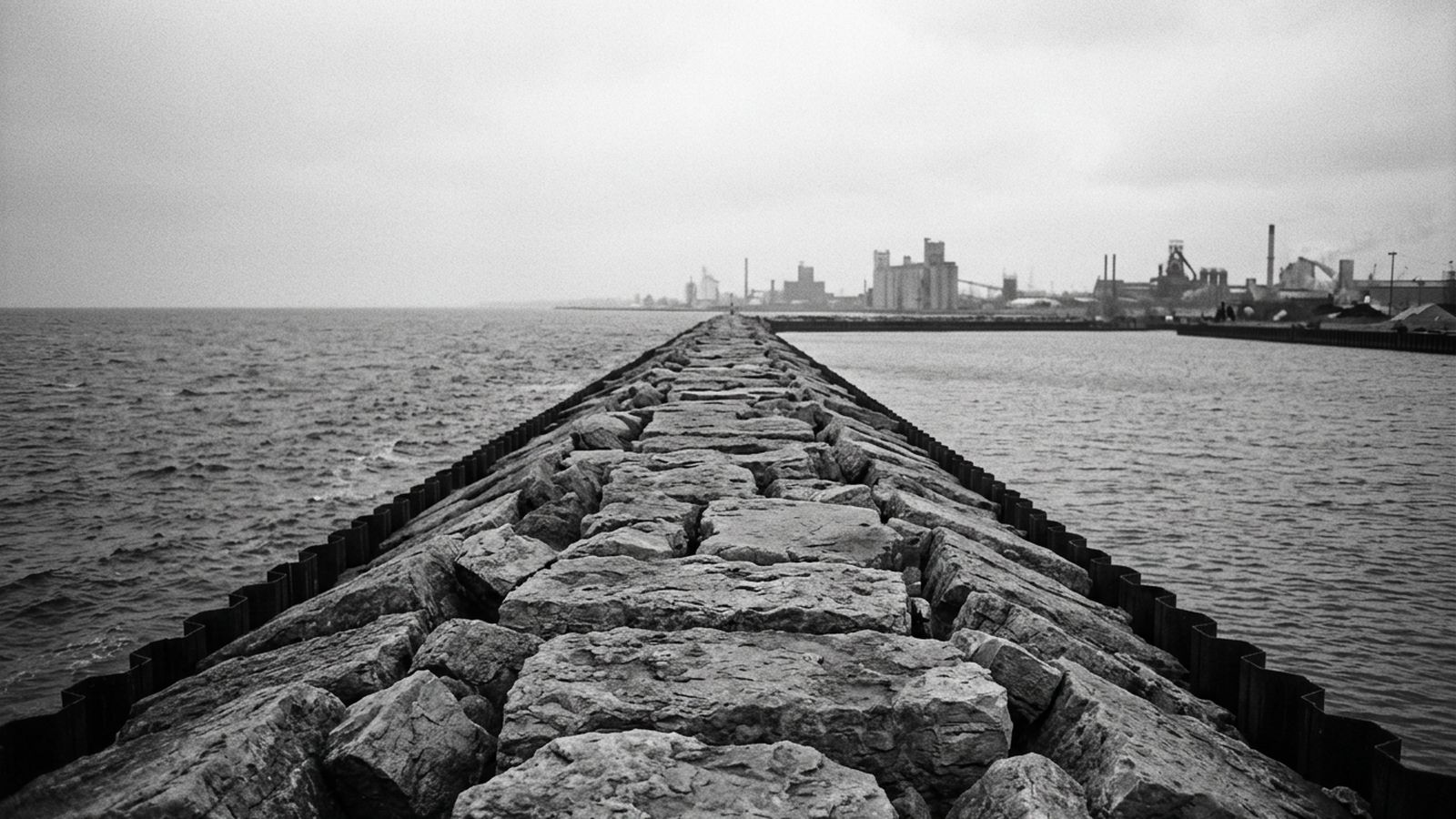
Where you stand: out along a stone wall at the harbor mouth. What is wrong with it: a long walk out and back with no shelter at either end, uneven and slippery stone, no seating, and a real chance that nothing comes while you are there.
The honest premise
Everything else in this publication is about a mechanism you can rely on being there. A span is there whether it opens or not. A dock is there whether it is working or not. Out here there is nothing except water and stone, and if no hull comes, you have looked at water and stone for an hour.
This piece exists because that is the actual experience of the subject and nobody writes it down. Waiting is not the price of the activity. It is the activity.
The walk out
Longer than it looks and less sheltered than you expect. Uneven stone, sometimes wet, occasionally with gaps, and no handrail for most of it. Wet stone at the end of a wall is genuinely slippery and the water beside it is deep.
Do not go out if the water is up. There is no discussion to be had about this: an outer wall in rough water is a place where people are hurt, and there is nothing at the end of it worth that.
Allow twice as long as the distance suggests, in both directions, and take what you need with you because there is nothing out there.
What you are actually there for
The turn.
Everywhere else in this subject a hull is moving in a straight channel between banks. Here it is coming in off open water and changing direction to enter, and that is the one place you can see a large hull do something rather than just proceed.
It is slow. A long hull does not turn, it is worked around, and the sequence is a series of small corrections that only make sense if you watch the whole thing. From out on the wall you get it in profile, with open water behind for scale, and the scale is the thing: a hull that looked like a building in the channel looks like a small object against the horizon, which recalibrates everything you thought you knew about the size of the water.
The first twenty minutes
Nothing. Get used to it.
What to do with them, in order of usefulness:
- Work out the sight lines. From how far out can you see something coming? What is the first thing that appears, the superstructure or the hull? Knowing that turns the next forty minutes from waiting into watching.
- Read the wall. It is a piece of engineering too, built to take weather rather than to carry anything, and its cross section, its capping and its joints are all decisions somebody made.
- Look back at the city. This is the only place in the subject where you can see the whole arrangement from outside it, and the relationship between the built up part and the working part is much clearer from the water side.
- Listen. Sound carries out here in a way it does not in the valley, and a whistle from a span a mile inland is audible, which tells you something is moving even though you cannot see it.
The second twenty minutes
If something is coming, this is usually when you first know. A shape that was not there, low and slow, on a bearing that does not change.
The interval between first seeing a hull and the hull being in front of you is longer than anybody expects: fifteen or twenty minutes is normal, because it is a large object moving deliberately and there is a great deal of water. Use it. This is the best time to walk to a better position on the wall, because you have plenty of it and you will not have any once the turn starts.
The third twenty minutes
Either the turn, or the decision to go back.
If it is the turn, stay where you are and stop moving about. The whole event is five to ten minutes and there is no better position than a decent one you are already standing in.
If it is the decision, make it cleanly. Walking back along a wall in fading light is worse than walking back in good light, and there is no shelter to wait in.
The thing nobody admits about this subject
You will have unsuccessful visits. Not occasionally: regularly. The tonnage moving through here is large but the number of arrivals in a day is small, and the chance that one of them coincides with an hour you chose in advance is not high.
Anybody who writes about this and implies otherwise is either lucky or lying. The correct response is to arrange the hour so that it is worth having anyway, which is why this piece spends most of its length on what to do with the empty part.
What this place is not
It is not the place for a first visit. A first visit puts it last and optional for exactly this reason: it is the best sight in the subject and the worst use of a first afternoon.
It is also not a fishing guide, a wildlife piece or a sunset location. Those are other people's subjects and they are well covered. This is about a hull changing direction.