Watch 03
Three Cargoes, Three Berths, and Why They Look Nothing Alike
Where you stand: two street ends on the valley floor and one shore road. What is wrong with it: industrial road with truck traffic, frequently no sidewalk at all, and a rail crossing that can close for a long time behind a slow move.
The premise
The same channel, three berths within a short distance of each other, and three arrangements that share almost nothing. If you want to understand why cargo handling looks the way it does, this is the comparison to make in one visit, because the differences are not subtle and they are all visible from the street.
Berth one: ore
A long hull, a boom swung out and down, and a stream that does not stop.
The sound is the first surprise. From two hundred feet away it is a continuous rush, closer to running water than to anything falling. There are no individual impacts because the pellets are small and uniform and there are a very great many of them.
The pile grows along one axis rather than upward in the middle. The boom is fixed at its pivot, so the fall point sweeps a line, and by the end of a shift the pile is a long ridge rather than a cone. If you come back three hours later you can see how far along the ridge the work has got, which is the most legible measure of progress in the whole valley.
The hull is the other lesson. When work starts it sits low, with hardly any side plating out of the water. When it finishes it rides high enough that you can see the whole flank and the rubbing strakes. Watching that change over a shift teaches you what tonnage means better than any figure.
Berth two: stone
Coarser, lighter per shovel, and noisier in a completely different way.
The sound is individual pieces landing. You hear the stream as a rattle rather than a rush, with distinguishable impacts, and the difference from an ore berth two minutes away is immediate.
The pile is steeper and slumps. Aggregate has an angle of repose it insists on, and when the fall point moves, the pile behind it settles audibly.
The trucks are the real difference. Ore mostly leaves a dock by rail or conveyor. Stone leaves by road, which means a scale, a queue and a gate, and that means the whole chain from hull to highway is visible in one place: hull to boom to pile to loader to truck to scale to street. There is nowhere else in this subject where you can see a cargo cross from water to road in a single view.
What is uncomfortable about a stone berth is the traffic that follows from that. This is a working truck route, the surface is chewed up, and there is often no sidewalk. Stand at the street end and do not walk along the road.
Berth three: salt, which is not a berth at all
Here is the part that surprises visitors, and the reason this piece exists.
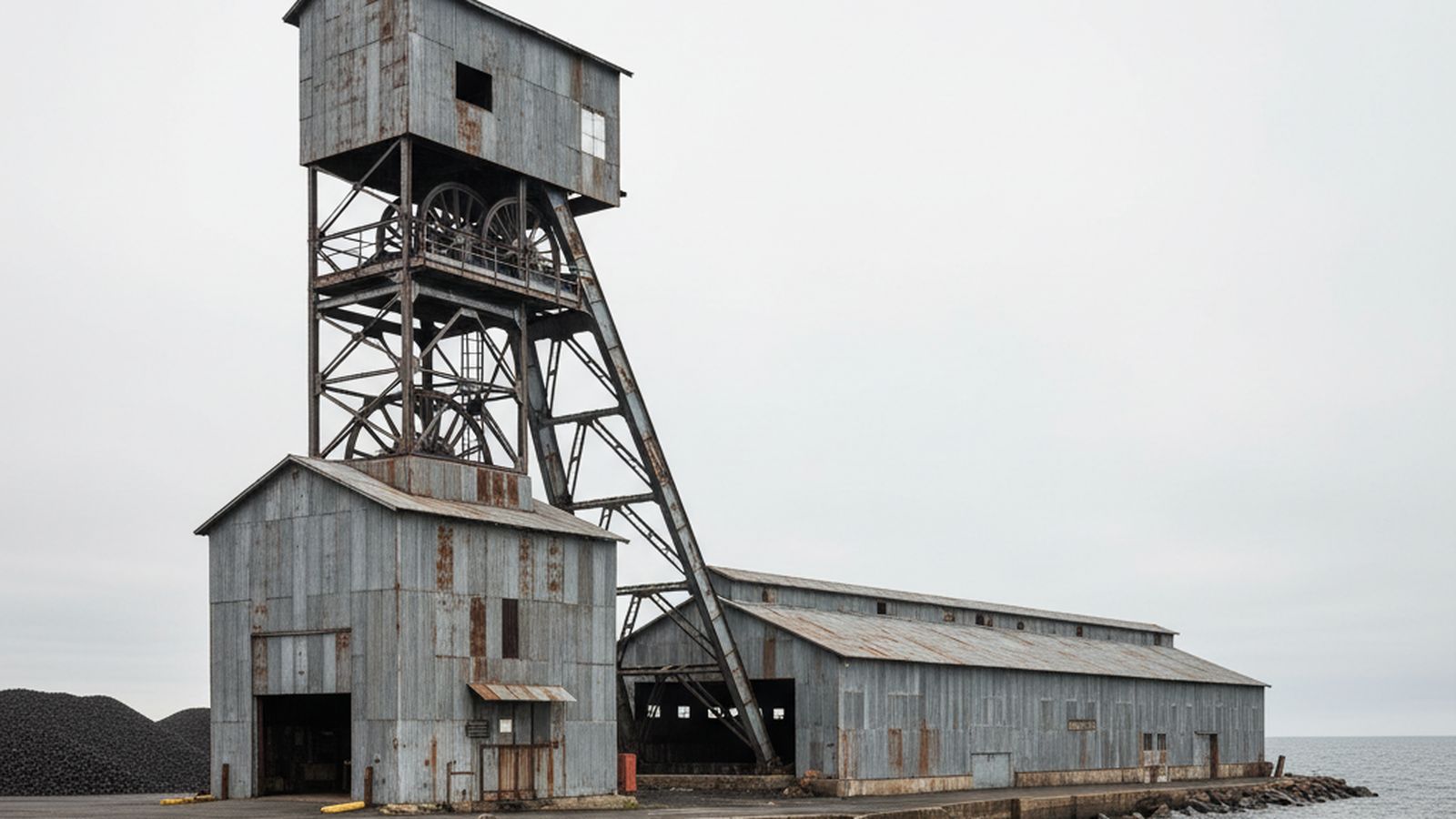
The salt is not brought in from somewhere else. It is mined from under the lake, and the shaft head is on the shore. So what you are looking at is not a handling arrangement at all: it is the top of a mine.
What is visible: a hoist house, a headframe, and a covered pile. What is not visible: everything interesting, because it is underground and always will be.
What it teaches, standing on the shore road, is the difference between a structure built to lift material vertically out of the ground and a structure built to take material sideways out of a hull. They look nothing alike, they are engineered for opposite problems, and the two are within sight of each other. A headframe is compact, tall and built around a single vertical line of force. A dock boom is long, horizontal and built around swing and reach.
And the roof. Salt cannot be left in the open, so the pile is inside. That single constraint explains why a salt operation reads as a building while an ore operation reads as a landscape of piles.
Doing all three in one visit
It works, and this is the order.
- 1. Stone first, because it is the noisiest and the busiest and it wakes you up to the scale of things.
- 2. Ore second, because after the rattle of stone the continuous rush of pellets is the contrast that makes the point.
- 3. Salt last, because it is the quietest and the most conceptual, and it is better appreciated when you already know what a dock looks like.
Allow for the crossing. A rail crossing on the valley floor can close for a long time behind a slow move rather than a train, and there is no way around it on foot.
What not to expect
You will not see every berth working. Two thirds of the tonnage here is ore, so on an ordinary day the ore operation is the most probable thing happening and the others may be idle. An idle berth still shows you the arrangement, which is most of what this piece is about.
You will not get a schedule, because nobody has one. And you will not be told which berth is which by name, because this publication does not name places. Street and type is what you get, and it is enough to stand in the right spot.